
September 19, 2026 / 8 Minute Read
a funny money study guide
Attached is a study guide for my Funny Money series, which details the history and function of the Federal Reserve and explores concepts like usury and fiat currency.
For those interested in funding a better future!
a brief history of money
Funny Money Vol. 1 lays the foundation for understanding the Federal Reserve by examining the history and basic principles of money. Beginning with barter, the article traces the development of commodity money, receipt money, fractional money, and ultimately fiat currency.
Drawing heavily from G. Edward Griffin’s The Creature from Jekyll Island, it argues that gold and other forms of commodity money historically provided a stable store and measure of value, while fractional-reserve banking allowed banks to irresbonsibly expand the money supply beyond their actual reserves.
The article concludes by examining fiat currency, money without commodity backing, and argues that continual expansion of the money supply reduces purchasing power, making inflation function as a hidden tax on savings and wages.
Key Takeaways:
- Knowledge of the nature of money is essential to understanding the Federal Reserve. For the purposes of this study, money is defined as anything which is accepted as a medium of exchange.
- There are four kinds of money: commodity, receipt, fiat, and fractional. Precious metals were the first commodity money to appear in history and have since been proven by actual experience to be the only reliable base for an honest monetary system. Gold, as the basis of money, can take several forms: bullion, coins, and fully backed paper receipts.
- Man has been plagued throughout history with the false theory that the quantity of money is important, specifically that more money is better than less. This has led to perpetual manipulation and expansion of the money supply through such practices as coin clipping, debasement of coin content, and in later centuries, the issuance of more paper receipts than there was gold to back them. In every case, these practices have led to economic and political disaster.
- In those rare instances where man has refrained from manipulating the money supply and has allowed it to be a free-market production of the gold supply, the result has been prosperity and tranquility.
another look at the fed
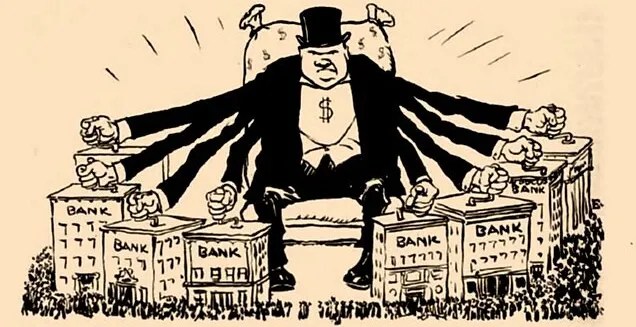
Funny Money Vol. 2 builds upon the monetary principles established in Volume 1 by examining the origins and operation of the Federal Reserve System. Beginning with the secret 1910 meeting at Jekyll Island, the article explores the influence of powerful banking interests in the Fed’s creation before explaining two concepts drawn from The Creature from Jekyll Island: the Mandrake Mechanism and the Rothschild Formula.
The Mandrake Mechanism describes how debt and bank lending artificially expand the money supply, while the Rothschild Formula presents war and national debt as mechanisms through which financial interests can profit and gain influence over governments.
Together, these concepts form the article’s central argument that a debt-based monetary system enables banks and governments to expand credit, generate inflation, profit from interest, and increase their economic and political power to the detriment of the populace.
Key Takeaways:
- The essence of the contemporary monetary system was the creation of money, out of nothing, by private banks’ often foolish lending.
- The basic plan for the Federal Reserve System was drafted at a secret meeting held in November of 1910 at the private resort of J.P. Morgan on Jekyll Island off the coast of Georgia. Those who attended represented the great financial institutions of Wall Street and, indirectly, Europe as well. The reason for secrecy was simple. Had it been known that rival factions of the banking community had joined together, the public would have been alerted to the possibility that the bankers were plotting an agreement in restraint of trade, which, of course, is exactly what they were doing.
- The entire function of the Mandrake Mechanism is to convert debt into money. Congress and the banking cartel have entered into a partnership in which the cartel has the privilege of collecting interest on money which it creates out of nothing, a perpetual override on every American dollar that exists in the world. Congress, on the other hand, has access to unlimited funding without having to tell voters their taxes are being raised through the process of inflation.
- All that is necessary to ensure that a government will maintain or expand its debt is to involve it in war or the threat of war. The greater the threat and the more destructive the war, the greater the need for debt.
monopoly money

Funny Money Vol. 3 concludes the series by considering the future of the Federal Reserve system and presenting a potential alternative. The article first explores Griffin’s warning that unchecked fiat-money creation, government debt, inflation, and increasing international financial centralization will ultimately produce economic and political turmoil.
It then turns from diagnosis to solution, organizing Griffin’s proposed monetary reform into five phases: ending the Federal Reserve Note’s monopoly, establishing a precious-metal-based dollar, settling the debts and obligations of the existing system, converting the country to the new currency, and ultimately abolishing the Federal Reserve while introducing free banking and reducing government dependence on monetary expansion.
The article concludes that abolishing the Fed alone would be insufficient; lasting monetary reform would require both a carefully managed transition and an alternative system designed to prevent the problems attributed to fiat currency and centralized banking from reemerging.
The Solution in Short:
- Phase I — Create monetary competition
- Steps 1–2 remove the Federal Reserve Note’s privileged position and stop expanding its supply.
- Phase II — Create the replacement currency
- Steps 3–5 redefine the dollar around silver, permit gold to circulate alongside it, and restore precious-metal coinage.
- Phase III — Liquidate the old system
- Steps 6–9 address the national debt, dedicate government precious metals to redemption, and calculate the exchange rate between Federal Reserve Notes and the new dollar.
- Phase IV — Make the conversion
- Steps 10–12 redeem Federal Reserve Notes, convert existing contracts, and introduce fully backed paper certificates.
- Phase V — Prevent the old system from returning
- Steps 13–16 abolish the Fed, restructure banking, reduce government, and pursue Griffin’s broader conception of national sovereignty.
Key Takeaways:
- The Federal Reserve’s endless creation of fiat currency will eventually lead to economic collapse and societal ruin if left to continue unadulterated.
- America’s economy is being deliberately weakened through foreign giveaways and domestic boondoggles. The goal is not to help those in need or preserve the environment, but to bring the system down.
- The Federal Reserve, in collaboration with sister organizations like the United Nations, Council on Foreign Relations, and International Monetary Fund, seeks to create a one world order with a global government, bank, and military ruled under the principles of socialism.
- A plan for the restoration of the economy must eliminate the Federal Reserve as it currently operates, address all the lingering issues it has created since its inception, and provide an alternative money system for the future.
a note from the author
The best investment one can make at this time is to finance an educational crusade. Americans have allowed their nation to be stolen from right under their noses because they did not understand what was happening. There is no hope for the future as long as that condition remains. The starting point for any realistic plan for survival and beyond is America’s awakening.
The Creature from Jekyll Island: Pg. 586
How to join the Crusade:
- Become self-informed. That’s not as easy as it sounds. It involves a major commitment of time and money for books, recordings, and seminars. Do it.
- Form or join ad-hoc committees, along with other like-minded friends, to promote specific projects and programs. This is an excellent way to apply pressure to the political structure while attracting support from new people who share your objective. When choosing an organization, look for experienced, principled leadership that has proven it understands the deeper issues and cannot be sidetracked by the Cabal.
- Expand your influence within the community. Become known and respected for your knowledge. Join groups which are influential within your city or profession. Political groups are particularly important, regardless of party. Volunteer for work and seek a leadership role. Personally visit your city and county politicians and maintain ongoing communication. If you have the talent and the aptitude, consider running for some kind of public office yourself.
- Use politics, don’t be used by it. We got into our present mess through politics, and we must get out the same way; but getting out is a lot harder than getting in. The strategy, however, is simple: remove the big-spending internationalists from office and replace them with men and women dedicated to sound money and national independence. But beware! Never allow loyalty to the party to override loyalty to principle. Political parties are always controlled from the top, and the major parties are controlled by the very forces we must oppose.
Hope this helps!
Bye Chance!
references
Griffin, G. Edward. The Creature from Jekyll Island: A Second Look at the Federal Reserve. American Media, 2010.

