
April 30, 2022 / 10 Minute Read
edward bernays: father of finesse
“If we understand the mechanisms and motives of the group mind, it is now possible to control and regiment the masses according to our will without their knowing it. In almost every act of our daily lives, whether in the sphere of politics or business, in our social conduct or our ethical thinking, we are dominated by the relatively small number of persons who understand the mental processes and social patterns of the masses. It is they who pull the wires which control the public mind.“
– Edward Bernays
I will be drawing most of the information in this article from two of Bernays’ self-published books, those being Crystalizing Public Opinion and Propaganda.
If you’re reading this, I’m sure you’re aware of the propaganda and social engineering present in contemporary mainstream media.
In fact, the mainstream media is completely controlled and censored, and its main purpose is to align the actions of the masses with the agendas of the powers that be. I’m sure you’ve heard of the “shadow government”, working behind the scenes, pulling the strings, and doing the things that steer and guide the sheeple.
All mass media propaganda is governed and directed by a group of proverbial magicians known as the public relations counsel. They constitute the shadow government working behind the scenes, acting as advisors for the umbrella corporations that govern our society.
It is here where we find the puppet masters behind the social engineering and psychological warfare that have dictated the actions of the masses for millennia, and it is also where we meet the architect of modern day public relations and propaganda in the character of Edward Bernays.
By analyzing the work of Mr. Bernays, I believe one will clearly be able to recognize not only the cabal of puppeteers guiding and directing public opinion, but also the reality that much of the propaganda and social engineering promoted by the media, major corporations, and government are not in the interest of the proletariat, but often to their detriment.
So who is Edward Bernays?
“Nicknamed “the father of public relations,” Edward Bernays (1891-1995) was a pioneer in the fields of propaganda and public relations, combining theories on crowd psychology with the psychoanalytic ideas of his uncle, Sigmund Freud, to become the first thinker to explain how corporations and politicians could manipulate public opinion. His seminal 1928 book Propaganda laid out how propaganda could be used to regiment the collective mind in a variety of areas, including government, politics, art, science, and education.”
Via: Crystalizing Public Opinion, Edward Bernays
Yes, you read that right.
Also, notice the familial connection between Edward Bernays and Sigmund Freud. Freud is basically the father of contemporary psychology. He developed the theory of psychoanalysis, which explains the origins and reasonings of human behavior and mental illness. Most of our modern information on the innerworkings of the conscious and unconscious/subconscious mind are a result of his theories.
So we know that Edward Bernays is literally related to the father of modern psychology, clearly indicating his understanding of crowd psychology, as well as human nature and motivations.
Could you imagine if this person decided to use this knowledge, not to inform, but to direct and manipulate people’s actions based on personal agendas?
Well….that’s exactly what happened.
“Bernays was the nephew of Sigmund Freud and he shared his uncle’s fascination with the unconscious mind. But while Freud sought to liberate people from their subconscious drives and desires, Bernays wanted to harness those passions for commercial ends.”
Via: https://www.cbc.ca/news/world/how-ww-i-helped-entrench-the-art-of-mass-persuasion-1.2684519
Let’s evaluate three historical examples of Bernays’ social engineering techniques in full effect.
bacon and eggs
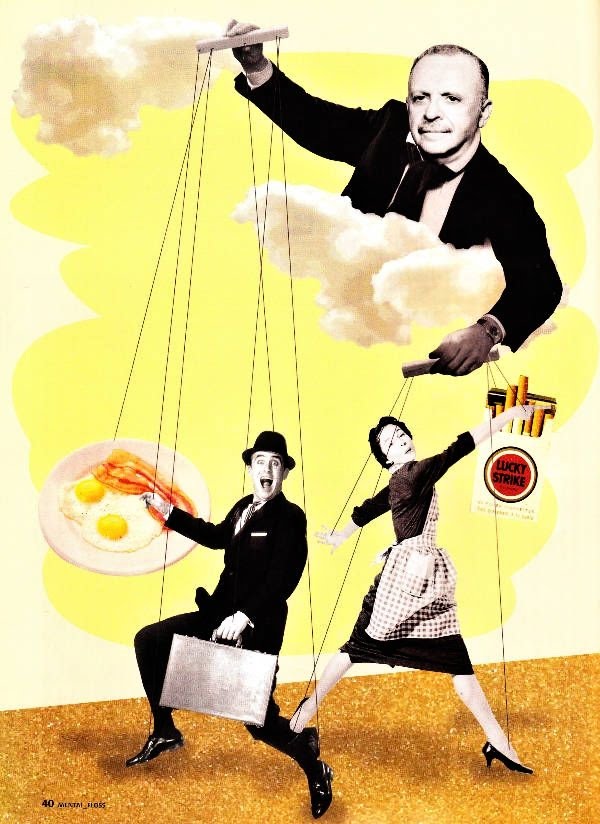

Bacon and Eggs have become a staple product of American breakfast. However, this wasn’t always the case. In the 1920s, the Beech-Nut Packing Company wanted to sell more bacon. So it hired Edward Bernays. At the turn of the 20th century, a light breakfast was the norm in America. Most people had coffee and a roll, maybe some cereal. So Bernays asked his agency’s doctor if a larger meal in the morning would be better for people’s health. The doctor said yes – more energy at the start of the day is a good thing. Bernays then had the doctor write to 5,000 of his closest doctor friends asking if they agreed. More than 4,500 wrote back saying they did. That gave Bernays a story to pitch. “4,500 physicians urge Americans to eat heavy breakfasts to improve their health” the newspaper headlines read. Many of them also referenced bacon and eggs as the perfect hearty breakfast. Rather than trying to sell or advertise his product directly, he turned to experts his customers trusted to tell the story. He highlighted a problem for consumers and let them find their way to his product as a solution. Today, 70 percent of bacon is eaten at breakfast. Bacon and eggs is an iconic American combo. All thanks to Edward Bernays.
Via: https://gobraithwaite.com/thinking/edward-bernays-and-why-we-eat-bacon-for-breakfast/
There are much healthier alternatives to bacon and eggs for breakfast. The reason why Bernays chose these dishes was not for health and well-being of the people, but for the benefit of of his sponsors at Beech-Nut Packing.
smoking
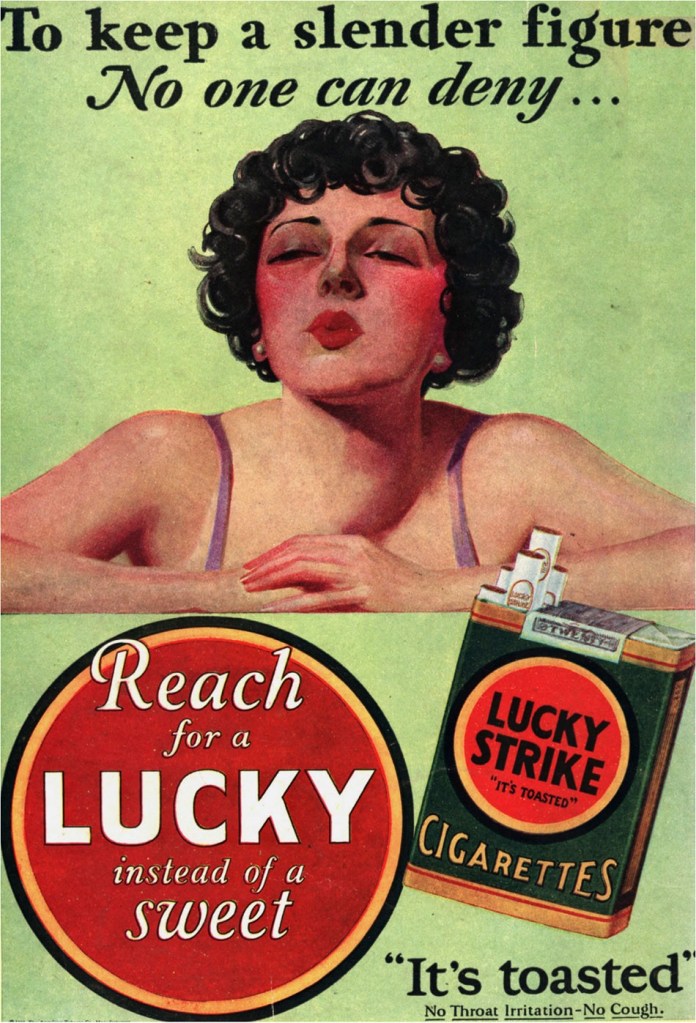
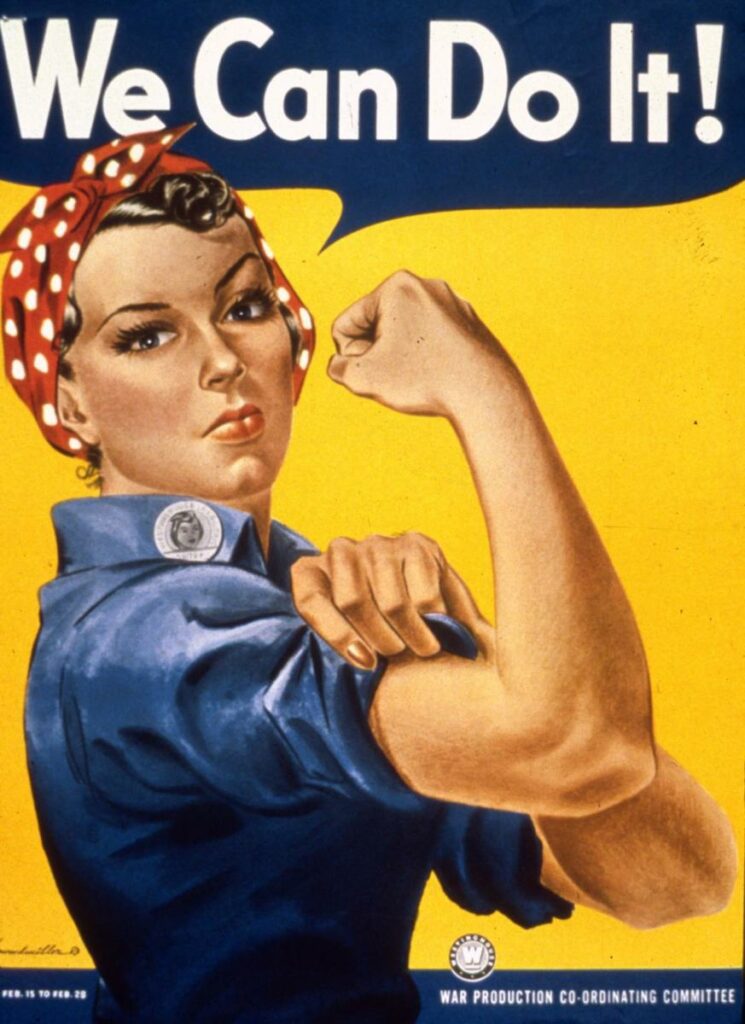
Originally, there were misconceptions that women do not smoke, particularly those that were considered nice or good girls. Indeed, while tobacco had been consumed in America in the late nineteenth century, it was not until 1929 that women were really expected or even allowed to partake in the consumption of tobacco products. Nonetheless, fifty years after cigarettes came into circulation, female smoking began to become acceptable and even socially desirable: “This was due not only to the dramatic changes in the social and economic status of women over this period but also to the way in which the tobacco industry capitalized on the changing social attitudes towards women by promoting smoking as a symbol of emancipation, a “torch of freedom.” Edward Bernays, the Father of Modern Public Relations, created the “Torches of Freedom” campaign in 1928, which increased the female market an in turn enhance the American Tobacco Company’s profit.
Bernays believed: “The conscious and intelligent manipulation of the organized habits and opinions of the masses is an important element in democratic society.” As a result, Bernays stated that he could encourage women to smoke by linking cigarettes to notions of freedom and rebellion. In 1929, Bernays encouraged women to march down Fifth Avenue during the Easter parade in New York City, and protest against gender inequality. Bernays telegrammed thirty debutantes from a friend at Vogue to participate in the demonstration, encouraging them to combat the prejudice against women smokers. By the 1930s, the tobacco industry became more sophisticated and used a diverse range of messages to promote products to the female market. Freedom became equated to female intrusions into male public space. Indeed, woman used smoking to challenge gender norms regarding tobacco consumption.
Via: https://biblio.uottawa.ca/omeka2/jmccutcheon/exhibits/show/american-women-in-tobacco-adve/torches-of-freedom-campaign
We see here that Bernays acted as a precursor for the feminist movement that has become so pervasive in modern society. Interestingly enough, Bernays strongly disapproved of his wife’s own personal smoking habit and even went so far as to throw her cigarettes away, citing the negative health effects.
world war 1
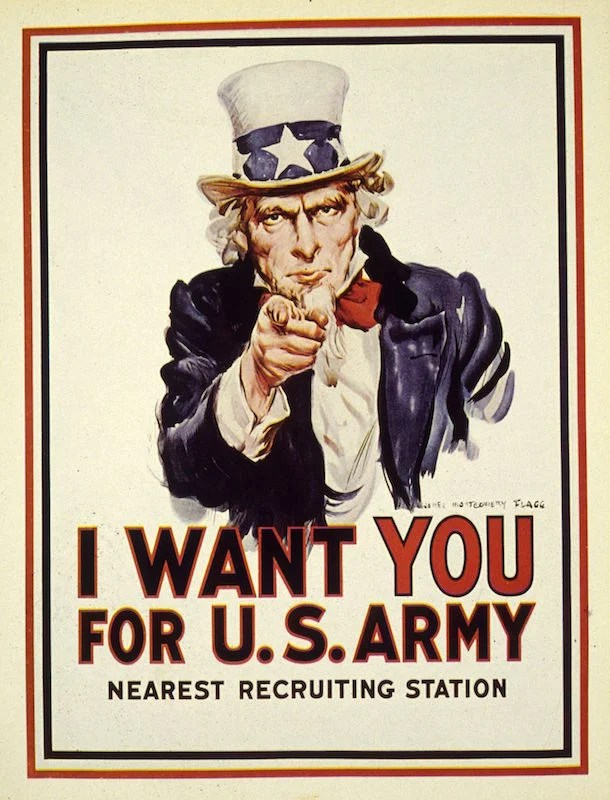
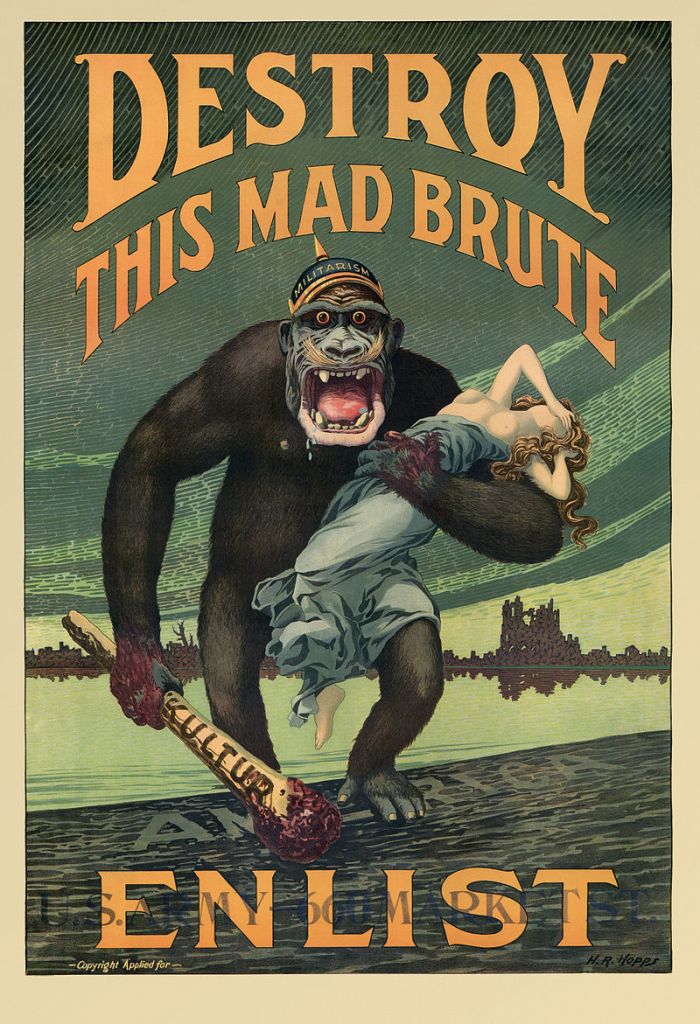
Before World War 1, The American public had a strongly individualistic and nationalistic identity. They were much more concerned with the problems within their own country, rather than global affairs. However, this all changed after President Woodrow Wilson authorized the creation of the Committee on Public Information.
The CPI was tasked with winning the war at home by firing up a reluctant American population into what Creel called “the white hot mass of patriotism,” and spreading the good news about America and its democratic values throughout the world. The CPI brought together many of the brightest minds in advertising, journalism, graphic design, academia, and a relatively new industry called public relations. By the end of the war, more than 100,000 Americans had contributed to the CPI’s efforts. They created Uncle Sam and other iconic recruiting images. They churned out millions of press releases, bulletins, photographs and posters, and produced silent movies with names like Pershing’s Crusaders and America’s Answer. The success of the CPI opened the eyes of many of its publicists to new techniques of mass persuasion, and brought the fledgling public relations industry from the fringes of American commerce into the mainstream.
The CPI was the largest propaganda machine the world had ever seen. And while its title stressed “information,” the Committee’s publicists understood that electrifying American public opinion would take an appeal to the emotions, not the intellect. The CPI’s Division of Advertising churned out posters and ads that depicted German atrocities that never happened, played up threats to American homes and families that were wildly exaggerated, and generally appealed to the fears and anxieties that lurked beneath the surface of public consciousness. All of this was observed with great interest by a young member of the CPI team named Edward Bernays.
Via: https://www.cbc.ca/news/world/how-ww-i-helped-entrench-the-art-of-mass-persuasion-1.2684519
This is the power of the public relations council; modern day wizards, mercenaries for hire, consciously manipulating and directing the masses through carefully orchestrated psychological warfare and spellcasting.
As we can see, these propaganda campaigns were never about the health and wealth of the American people. To the contrary, the sole purpose of these campaigns was for the advancement of big business, government control, and corporate capitalism. Major corporations and governments finance and utilize members of the public relations counsel to brainwash and direct the public towards its desired goals and agendas, often negating the negative effects these actions will have on the masses.
And this was all primarily started and influenced by Edward Bernays.
Make sure you remember that name.
Ever wonder why they don’t teach us this stuff in school?
To end, take a look at a few quotes from Edward Bernays himself, describing his views on the use propaganda and the public relations council:
“Any person or organization depends ultimately on public approval, and is therefore faced with the problem of engineering the public’s consent to a program or goal.”
“Democracy is administered by the intelligent minority who know how to regiment and guide the masses.“
“A presidential candidate may be “drafted” in response to “overwhelming popular demand,” but it is well known that his name may be decided upon by a half dozen men sitting around a table in a hotel room.”
“In some departments of our daily life, in which we imagine ourselves free agents, we are ruled by dictators exercising great power.”
“We govern what the public think about.”
“If you can influence the leaders, either with or without their conscious cooperation, you automatically influence the group which they sway.”
“Propaganda will never die out. Intelligent men must realize that propaganda is the modern instrument by which they can fight for productive ends and help to bring order out of chaos.”
These quotes were taken from the book Propaganda by Edward Bernays.
bye chance.
references
Bernays, Edward. Crystalizing Public Opinion. Edited by Stuart Ewen, IG Publishing, 2011.
Bernays, Edward. Propaganda. IG Publishing, 2004.
https://gobraithwaite.com/thinking/edward-bernays-and-why-we-eat-bacon-for-breakfast/
https://www.cbc.ca/news/world/how-ww-i-helped-entrench-the-art-of-mass-persuasion-1.2684519
https://www.goodreads.com/author/quotes/275170.Edward_L_Bernays
 by chance